You found it. The house that made you stop scrolling.The kitchen works. The location works. You can picture your furniture in the living room. You've already figured out where the dog bed

Dated: September 18 2026
Views: 94
You found it. The house that made you stop scrolling.
The kitchen works. The location works. You can picture your furniture in the living room. You've already figured out where the dog bed is going. And now comes the question almost every buyer eventually asks me:
“Jane, what should I offer?”
My answer isn't automatically the asking price. It isn't automatically $10,000 under asking. And it definitely isn't:
“You love it? Let's throw everything at it!”
Before we decide what to offer, we need to figure out two different things:
What is the house worth?
and
What will it take to put together the strongest offer for this house today?
Those are related questions. But they aren't the same question.

Before we start talking about what you should offer, I want to know whether I think the asking price makes sense. Is it priced about where it should be? Is it overpriced? Or did the seller price it aggressively because they expect the market to push the price higher? I can give you my initial impression, but when you're serious about writing an offer, I'm going to dig deeper.
I'll prepare a Comparative Market Analysis, or CMA, for the property. A CMA helps us look at what similar homes have actually sold for and how this particular home compares.
I'm looking at things like:
Recent comparable sales
Location and proximity
Square footage
Bedrooms and bathrooms
Overall condition
Renovations and updates
Parking
Other property features that affect value
The list price tells us what the seller is asking.
The CMA helps us understand what the market says.
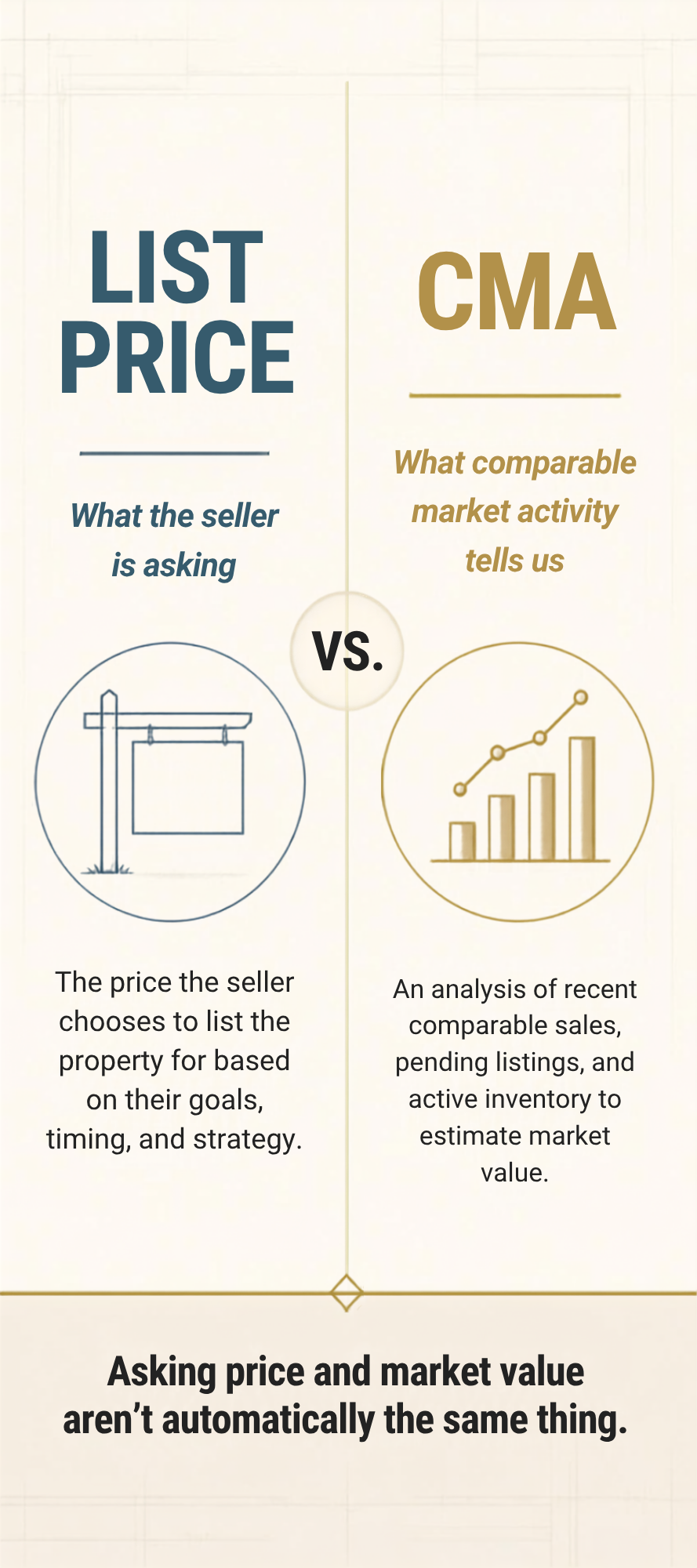
This is an important distinction. If a house has been sitting on the market for 45 days or has already had two price reductions, that doesn't automatically mean the house is worth less.
But it tells me something else that's extremely useful: We may have negotiating room.
Days on market, price reductions, previous contract activity and current buyer interest help me determine how aggressively we might negotiate.
Could we offer less?
Could we ask for more seller assistance?
Could we negotiate buyer-agent compensation?
Could we potentially do some combination of those things?
That's different from determining the property's actual market value.
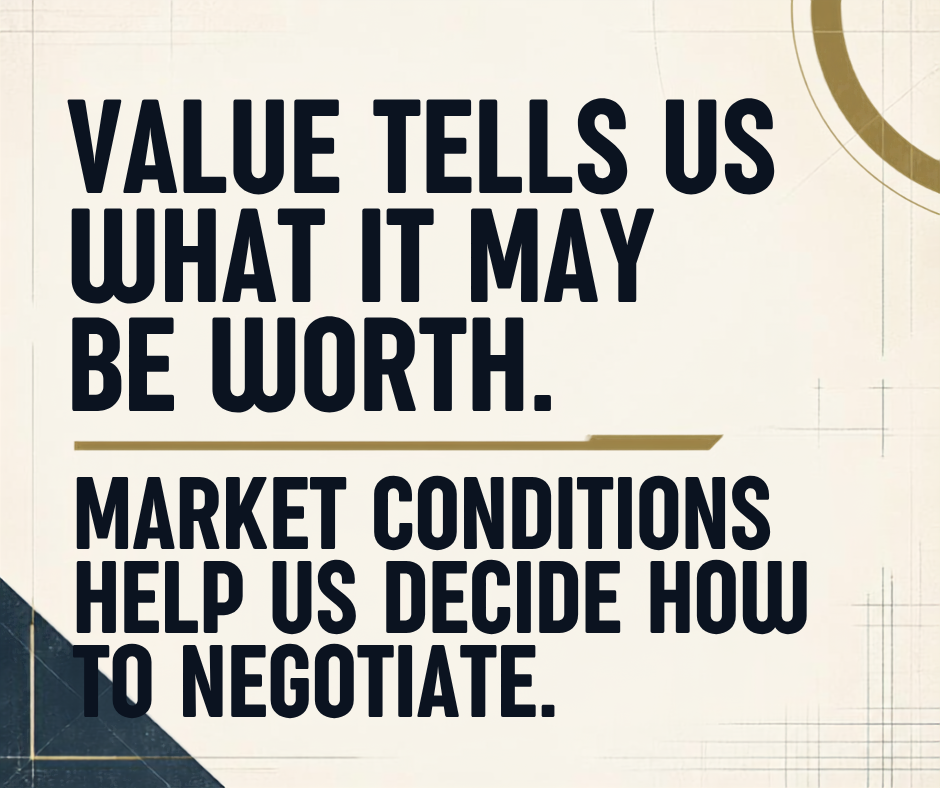
This is where buyers sometimes get surprised. Suppose a home is listed for $300,000. A $300,000 offer isn't necessarily the same offer financially if one buyer is asking the seller for significant assistance and another buyer isn't.
We have to look at the whole offer. Maybe you need the seller to contribute toward allowable closing costs. Maybe you're asking the seller to pay some or all of your buyer-agent compensation. Maybe there are other terms that matter financially to the seller. The amount a seller can contribute toward a buyer's costs can also depend on the buyer's loan program, lender guidelines and the particular transaction.
So instead of asking only: “How low can we offer?” I want to know: “What do you need from the seller, and how do we structure the strongest offer that still accomplishes your goals?”
Because I generally don't want to ding the seller hard on price and ask them to give us everything else unless the market gives us a reason to believe we can. That's strategy.
Let's use a simple example. Imagine a house is listed at $300,000 and our CMA supports the value. You love it. But you also need seller assistance with your closing costs. If there isn't much buyer activity and the property has been sitting on the market, we may have room to negotiate both the price and some help from the seller.
But what happens if there are three other buyers interested?
Now we have a different conversation. If you qualify for the higher purchase price and the numbers make sense, we might structure the offer differently; potentially increasing the price while asking for the assistance you need. Why?
Because we're trying to put together your strongest offer on that home today.
Not yesterday's offer.
Not your friend's offer from three years ago.
Not something you read in a Facebook group.
This house. This seller. This buyer. This market. Today.

One of the mistakes buyers make is hearing something like: “It's not a crazy seller's market anymore.” and translating that into: “Great! Every seller should take less.” It doesn't work that way.
We can be in a market where buyers and sellers generally have room to have conversations and negotiate, and then walk into one beautifully renovated Baltimore rowhome that gets multiple offers its first weekend.
The overall market and the market for one particular house aren't always the same thing.
That's why I want to know: How long has THIS home been listed? Have there been price reductions? Are other buyers interested? Is there an offer deadline? What are comparable properties doing? What does the listing agent tell me about activity?
That's the information that helps us decide how aggressive or how conservative we should be.
Before we write the offer, I routinely talk with the listing agent. Especially when there's competition. I want as much information as I can appropriately gather about what matters to the seller. Maybe price is their biggest priority. Maybe timing matters. Maybe they need a particular settlement date. Maybe there's another term that's extremely important to them but relatively easy for my buyer to give them. That's valuable information.
Because sometimes we can make an offer more attractive to a seller without simply throwing more money at the house. Some things are easy for my buyer to give. Some aren't. Our job is to figure out which is which.
Maryland REALTORS® makes a similar point in its guidance on escalation offers: sellers may evaluate contingencies, timing and other terms in addition to the dollars they'll receive.
Now things get interesting. Your $300,000 house has multiple offers. You ask: “Jane, just tell me what I have to offer to get it.”
I can't know exactly what another buyer is willing to pay. And I don't want you randomly throwing an extra $20,000 at the seller because you're afraid of losing the house. This is one place where an escalation clause can sometimes become my friend.
An escalation clause can allow us to write an offer that increases in response to a qualifying competing offer by a predetermined amount, up to the maximum you've authorized.
For example, rather than simply jumping straight to your maximum price, the offer might essentially say: I'll beat a qualifying competing offer by $X, up to my maximum of $Y.
That doesn't mean an escalation clause is right for every transaction, and a seller doesn't have to accept one. But in the right situation, it can help us compete without automatically throwing all of your money at the house.

I ask buyers a question. “At what price that you can comfortably afford would you be mad that you lost this house?” Think about that. Maybe you offered $300,000 and someone else gets it for $301,000. Are you going to spend the next month saying: “I would have paid $301,000!” Okay.
What about $305,000? $310,000?
Eventually we reach a number where you say: “No. If somebody wants to pay more than that, they can have it.” That's useful. Because now we know your line. Your maximum shouldn't be a number created by panic.
It should be a number you can afford and live with; even if somebody else decides they're willing to pay more.
Now let's flip the situation. Our CMA suggests the house is worth around $300,000 to $305,000. There's no competition. You're not asking the seller for a ton of assistance.
But you LOVE it. And you tell me: “Let's offer $315,000. I don't want to lose it.”
I'm probably going to tell you: “I don't think you should do that.”
Here's the analogy I use. Imagine you're buying a car. The dealership has exactly the model you want in your favorite color. Nobody else is standing there trying to buy it.
Would you offer the dealer more money just because it's your favorite color?
Probably not.
So why would we do that with a house?
If competition or the terms of our offer give us a strategic reason to increase the price, that's one conversation. Paying extra simply because you've fallen in love with the house is another.
This one matters to me. When buyers hear “multiple offers,” they sometimes think the only way to compete is to remove every protection from the contract.
I don't recommend that.
There may be smarter ways to strengthen the offer depending on the situation.
I don't want you blindly giving up the opportunity to understand what you're buying. If timing allows, one option in a competitive situation may be having a pre-offer inspection performed before submitting the offer.
That lets us gather information before deciding how to proceed. HUD also recommends that buyers obtain a professional home inspection as part of the homebuying process.
Sometimes an appraisal-gap guarantee can strengthen an offer without completely eliminating the appraisal protection. For example, a buyer might agree to cover up to a predetermined amount if the appraisal comes in below the contract price.
That creates a defined risk rather than an unlimited one.
But you need to have the money available and understand exactly what you're agreeing to.
Changing financing protections is something I approach very carefully. Before we'd even discuss it, I want the buyer to be comfortable with the risk and I want their lender to be extremely confident in the loan.
Strong doesn't have to mean reckless.

Another way an offer communicates strength is the earnest money deposit, or EMD. In my transactions, around 1% of the purchase price is my typical starting point. That isn't a rule or required percentage. It's my general starting point when we're discussing strategy.
In a competitive situation, we may consider a larger deposit when the buyer has the funds available and it meaningfully strengthens the offer.
If a buyer truly needs to provide less, we can discuss that too, although it's generally not my preference when we're trying to demonstrate a strong commitment to the purchase.
And remember:
Earnest money isn't automatically an additional cost on top of everything else you're paying.
If the transaction proceeds to settlement, the deposit is generally credited toward the buyer's transaction at closing. The contract determines the circumstances under which earnest money may be refundable or at risk, which is another reason I want buyers to understand their contract protections rather than simply removing them.
When we're writing your offer, I don't want you staring at one number.
We're looking at the entire package.
PRICE
What does the CMA support?
SELLER HELP
Are we asking for allowable closing-cost assistance or other seller contributions?
BUYER-AGENT COMPENSATION
Are we asking the seller to contribute toward the buyer's brokerage obligation?
EARNEST MONEY
What deposit demonstrates strength while still making sense for you?
CONTINGENCIES
What protections do we need, and are there strategic ways to address competition without unnecessarily exposing you?
TIMING
Is there a settlement or possession timeline that's valuable to the seller and workable for you?
COMPETITION
Are we the only buyer—or one of five?
That's the offer. Not just the number at the top.

Remember our earlier conversation about affordability? Your lender's maximum approval doesn't automatically need to become your shopping budget.
There's another reason for that.
If you're pre-approved for exactly $300,000 and start falling in love with houses listed at $300,000, you've left yourself very little flexibility if the right house attracts competition.
Shopping comfortably within your budget can sometimes give us room to negotiate when the right opportunity comes along.
Increasing the price isn't the only thing that can affect the money you need. Your earnest money, down payment, closing costs, potential appraisal-gap commitment and seller assistance can all affect your transaction.
That's why I want us to understand the numbers before we're sitting at the kitchen table emotionally trying to win a house.
If you're not sure how much money you actually need to purchase, start with my previous article:
How Much Money Do I Actually Need to Buy a House in Baltimore?
Here's my answer:
The strongest offer isn't automatically the highest offer.
We start by understanding the home's market value. Then we look at the activity surrounding that particular property. We determine what you need from the seller. I talk with the listing agent and try to understand what matters to the seller. We consider your financing, cash, contingencies, earnest money, timeline and comfort level. If there's competition, we determine how strongly you want to compete and where your line is.
Then we put those pieces together.
Sometimes that means offering below asking. Sometimes it means offering asking price and requesting seller assistance. Sometimes it means going above asking. Sometimes it means using an escalation clause. And sometimes the strongest decision we can make is:
“If somebody wants to pay more than that, they can have it.”
The goal isn't simply to win.
If you're already looking at homes, or you're getting ready to start you don't have to figure out the offer strategy from an online calculator or a generic “offer X% below asking” rule.
Every house is different. Every seller is different. And every buyer is different.
Let's look at the property, the numbers, the market and your goals and build the strongest offer that makes sense for you.
LET'S BUILD MY HOMEBUYING STRATEGY →
A Home Changes Everything.
Because buying the home matters. So does how you buy it.
Not automatically. Start by looking at comparable recent sales and the property's condition and features to determine whether the asking price appears supported by the market. Then consider competition, days on market, seller priorities and the other terms you're requesting.
A Comparative Market Analysis can compare the property with recent nearby sales while accounting for factors such as location, size, bedrooms and bathrooms, condition, renovations, parking and other relevant features. The asking price itself doesn't establish market value.
Yes. Whether doing so makes strategic sense depends on the individual property and current market activity. A home that's been sitting on the market or has experienced price reductions may offer more negotiating room than a newly listed property attracting multiple buyers.
An escalation clause can increase a buyer's offer in response to a qualifying competing offer by an agreed amount, up to a predetermined maximum. It may be useful in some competitive situations, but sellers aren't required to accept escalation provisions.
I don't recommend automatically giving up important buyer protections simply to compete. Depending on the property, timing and circumstances, there may be other strategies to consider, including a pre-offer inspection when feasible.
An appraisal-gap provision can commit the buyer to covering some predetermined amount of a difference between the contract price and a lower appraisal. Buyers considering this strategy should understand the potential cash requirement and discuss the financing implications with their lender and real estate professional.
There isn't one amount that's appropriate for every transaction. Around 1% is a common starting point in my own buyer strategy, but the appropriate amount depends on the property, competition, buyer resources and terms of the offer.
No. Sellers can consider the overall terms of an offer, including price, requested seller contributions, contingencies, settlement timing and other contractual terms. That's why a strong offer is about more than simply choosing the highest number.

Jane HuelleREALTOR® | Mortgage Loan Officer | Homeownership AdvocateA Home Changes Everything.Because homeownership is more than buying a house—it's building your future.I didn't choose real....
You found it. The house that made you stop scrolling.The kitchen works. The location works. You can picture your furniture in the living room. You've already figured out where the dog bed
How Much Money Do I Actually Need to Buy a House in Baltimore?The simple answer? I usually tell buyers to plan for roughly 10% of the purchase price but that does NOT mean you need a 10% down.
What Credit Score Do I Need to Buy a House in Baltimore?Your credit score matters—but it isn't a pass/fail grade for homeownership.One of the most common things I hear from future homebuyers:
How Much House Can I Actually Afford in Baltimore?If you're thinking about buying a home in Baltimore, you've probably typed some version of this into Google:“How much house can I afford?;
Should you require assistance in navigating our website or searching for real estate, please contact our offices at 301-381-1855.

 © BRIGHT, All Rights Reserved
Information Deemed Reliable But Not Guaranteed
The data relating to real estate for sale on this website appears in part through the BRIGHT Internet Data Exchange program, a voluntary cooperative exchange of
property listing data between licensed real estate brokerage firms in which
participates, and is provided by BRIGHT through a licensing agreement.
The information provided by this website is for the personal,
non-commercial use of consumers and may not be used for any purpose other than to identify prospective properties consumers may be interested in purchasing.
Data last updated: September 23, 2026 3:16 PM UTC
Some properties which appear for sale on this website may no longer be available
because they are under contract, have Closed or are no longer being offered for sale.
Some real estate firms do not participate in IDX and their listings do not appear on this website. Some properties listed with participating firms do not appear on this website at the request of the seller.
Show More...
