How Much House Can I Actually Afford in Baltimore?

Dated: August 27 2026

Views: 87

How Much House Can I Actually Afford in Baltimore?

If you're thinking about buying a home in Baltimore, you've probably typed some version of this into Google:

“How much house can I afford?”

Maybe you've plugged your income into an online calculator and gotten a number.

$300,000.  $350,000.  $400,000.  Great.

But here's the problem:

A home price isn't a budget.

Two homes with the exact same asking price can have very different monthly costs.

And just because a lender may approve you to borrow a certain amount doesn't mean spending that amount will fit comfortably into the life you actually want to live.

So when I work with buyers, I don't want to start with:

“What's the most expensive house you can qualify for?”

I want to start with:

“What monthly housing payment allows you to own a home AND still comfortably live your life?”

Once we know that number, we can work backward toward a home price.

How Much House Can I Afford?

Here's the short answer:

You can comfortably afford a home when the total monthly housing cost fits your budget while still leaving room for your other expenses, savings, emergencies, and financial goals.

Your lender can determine how much you may qualify to borrow.

You determine how much you actually want to spend.

The Consumer Financial Protection Bureau makes this same distinction: the amount a lender is willing to lend you isn't necessarily the amount that comfortably fits your household budget. 

CFPB — How Can I Figure Out If I Can Afford to Buy a Home?

That's an important distinction.

Because I don't want you to be house rich and life poor.


Start With the Payment, Not the Price

Let's say you've decided you're comfortable spending approximately $2,500 a month on housing.  The next question shouldn't be:

“What's the payment on a $350,000 house?”

It should be:

“What purchase price gets me close to my comfortable $2,500 monthly housing budget?”

Then we start putting the pieces together.


Your Mortgage Payment Is More Than Principal and Interest

One of the easiest mistakes to make when looking at homes online is seeing an estimated mortgage payment and assuming that's what the house will cost you every month.

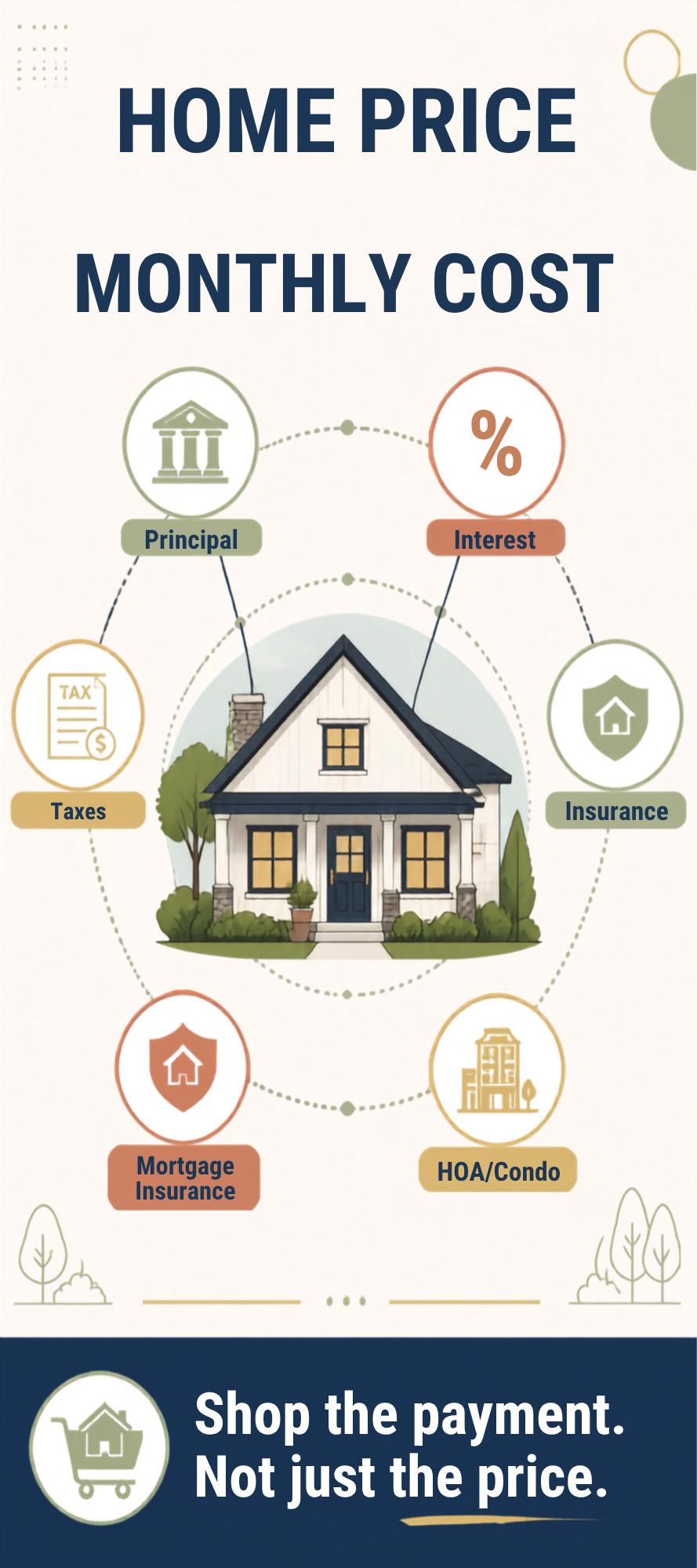
Your total housing payment may include:

Principal: The portion of your payment that reduces what you borrowed.

Interest: What you're paying the lender for borrowing the money.

Property Taxes: Taxes assessed on the property.

Homeowners Insurance: Insurance protecting the property.

Mortgage Insurance: Depending on your loan and down payment, mortgage insurance may apply.

HOA or Condo Fees: These aren't necessarily part of your mortgage payment, but they're absolutely part of your monthly housing budget.

The CFPB recommends considering the total monthly home payment, including principal, interest, taxes, insurance, mortgage insurance when applicable, and HOA fees, when determining what you can comfortably afford.

Why This Matters So Much in Baltimore 

This is where local knowledge becomes important.

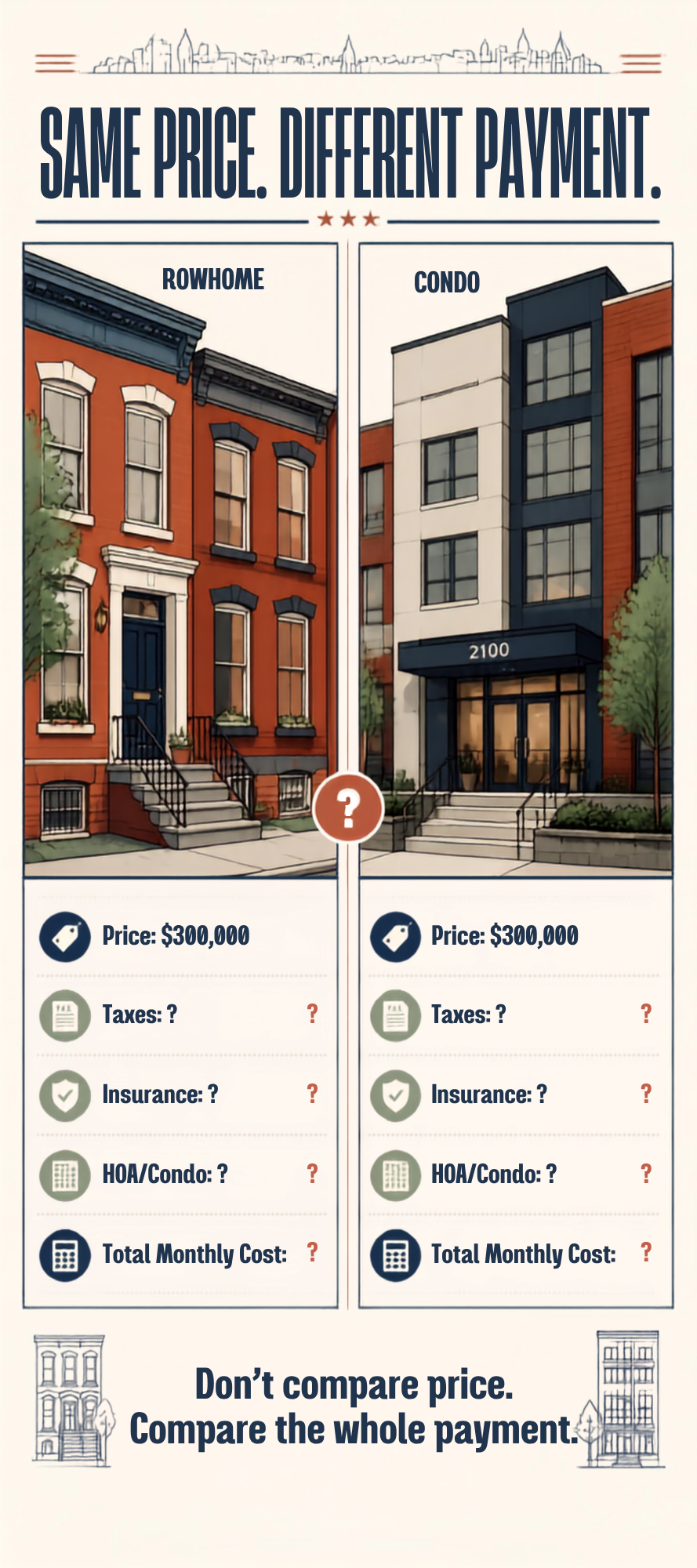
Imagine you're comparing two Baltimore homes listed at the same price.

HOME A — $300,000

A Baltimore rowhome with no HOA.

HOME B — $300,000

A condo with a monthly condo fee. Same purchase price. Not the same monthly housing cost.

Or maybe you're comparing a renovated rowhome in one Baltimore neighborhood with a similarly priced property somewhere else in the city. The taxes, insurance considerations, property condition, expected maintenance, and financing could make the real monthly costs different.  That's why I don't want my buyers shopping only by the number at the top of a listing.

Two $300,000 Baltimore homes can have two very different budgets.

Your Lifestyle Belongs in the Calculation 

Here's something a mortgage calculator can't know:

You.

It doesn't know that you love traveling.  It doesn't know that childcare is one of your biggest monthly expenses.  It doesn't know you're helping support a parent.  It doesn't know you're planning to replace your car next year.  It doesn't know that you refuse to give up your Friday night dinners out.  And it doesn't know whether having $500 left after paying your bills makes you comfortable or keeps you awake at night.

That's why I don't believe your maximum approval should automatically become your home-shopping budget.

When deciding what payment feels comfortable, ask yourself:

  • How much do I want left over every month?
  • Can I continue contributing to savings and retirement?
  • Will I still have an emergency fund after closing?
  • What other major expenses are coming?
  • Can I comfortably handle routine maintenance and repairs?
  • What do I enjoy doing that I don't want to give up just because I bought a house?

Homeownership should help you build your future.

It shouldn't consume your entire present.


Don't Forget the Costs That Aren't in the Mortgage Payment

Owning a home comes with expenses that may never appear on your mortgage statement.

Maintenance. Repairs. Utilities. Water. Furniture. Appliances. Moving. And the inevitable:

“Well, now that we own it, we should probably fix that...”

Freddie Mac recommends that prospective buyers account for both the upfront expenses of purchasing and ongoing costs such as insurance, taxes, routine maintenance, and future repairs when building a homeownership budget.

Freddie Mac — The Essential Guide to Creating a Homebuying Budget

That's why I want buyers to keep money available after closing.  Buying the house shouldn't leave your bank account at $12.43.


But What If I Don't Have a Huge Down Payment?

This is where affordability and opportunity start working together.

I've already talked about why you don't necessarily need 20% down to purchase a home. In my earlier article:  Think You Need 20% Down to Buy a Home? You Don't.

Your available cash can influence your price range, but that doesn't mean every dollar needed to purchase has to come from your savings account.

Depending on the buyer and property, there may be opportunities involving:

  • Down payment assistance
  • Closing-cost assistance
  • Employer benefits
  • Builder incentives
  • Seller contributions
  • Gift funds
  • Other eligible homebuying resources

That's why I don't want someone deciding: “I can't afford to buy.”

before we've figured out:  “What resources might actually be available?”

EXPLORE HOMEBUYING ASSISTANCE & OPPORTUNITIES →


Baltimore Opportunity Spotlight: Assistance Can Change the Equation

Baltimore buyers have another reason not to rely entirely on a generic national affordability calculator:

Local homebuyer incentives may change the numbers.

Baltimore City's Office of Homeownership maintains a First-Time Homebuyers Incentives Program and even provides an estimator that considers household income, loan amount, mortgage payment, down payment, and potential incentives. Eligibility and actual benefits depend on the buyer and program requirements.

That doesn't mean every Baltimore buyer will qualify.

It means we should investigate before assuming you don't.

This is exactly what I mean when I talk about finding opportunities.

The question isn't simply:  “How much money have you saved?”

It's:  “What resources, financing options, programs, and negotiating opportunities can we put together to create the right strategy?”


Interest Rates Matter. But They're Only One Part of Affordability

Yes, the interest rate affects your payment.  And yes, a different rate can change the price range that fits within your monthly budget.  But rates aren't the only variable.  Your down payment.  Your loan program.  Your taxes.  Insurance.  Mortgage insurance.  HOA or condo fees.  Available assistance.  Seller contributions.  And the price of the property itself can all affect the final numbers.

That's why I don't recommend building your entire homebuying plan around predicting what interest rates might do next.

Should I Wait for Interest Rates to Drop Before Buying a Home?

The better question is:  Do the numbers work for me today?

If they don't, we make a plan.


What If My Current Rent Is Lower Than the Mortgage?

Then we compare the whole picture.

Not:

Rent = $2,000
Mortgage = $2,300
Therefore renting wins.

We look at the costs and benefits of both.  We look at your timeline.  Your savings.  Your lifestyle.  Your future plans.  And whether homeownership fits your financial goals.

Is Renting Cheaper Than Buying a Home?

We're not trying to manufacture an answer that says:  BUY.  We're trying to find your answer.


From the Closing Table:
The Maximum Isn't the Goal

I've worked with buyers who qualified for more than they wanted to spend.  And I love when that happens.  Because my job isn't to convince someone to stretch their budget so we can shop at a higher price point.  My job is to understand what they want their life to look like after closing.  I want you to be able to furnish the house.  Take the vacation.  Go out to dinner.  Handle the unexpected repair.  Save for retirement.  And sleep at night.

A lender can help determine what financing you qualify for. A REALTOR® can show you what homes are available.  But you ultimately decide what payment allows you to live the life you want.

That's your real budget.


Turn the Number Into an Actual Home Search

Once you have a rough idea of the payment you're comfortable with, something fun happens.

We can stop talking hypothetically.

We can see what that budget actually buys.

SEE HOMES FOR SALE IN BALTIMORE →


So, How Much House Can You Actually Afford?

Here's my answer:

The right home price is the one that creates a total monthly housing cost you can comfortably afford while still leaving room for savings, emergencies, your other financial responsibilities, and the life you want to live.

Not the biggest pre-approval.  Not the prettiest online estimate.  Not what your friend bought.  And not what an internet calculator says you should spend.

Your number.

Start with your comfortable monthly payment.  Understand the full cost of owning the property.  Explore the financing and assistance opportunities available.  Then determine the price range that fits.  That's how we build a homebuying strategy.


Ready to Run Your Numbers?

You don't have to start by applying for a mortgage.

Start by exploring.

STEP 1 — ESTIMATE YOUR PAYMENT

STEP 2 — SEE WHAT YOUR BUDGET BUYS

STEP 3 — EXPLORE ASSISTANCE

And if you've done those things and you're thinking:

“Jane, I need someone to help me put all of this together.”

LET'S BUILD YOUR HOMEBUYING STRATEGY →


Frequently Asked Questions About Home Affordability in Baltimore

How much house can I afford in Baltimore?

The amount you can comfortably afford depends on your income, debts, available cash, loan program, interest rate, property taxes, insurance, potential mortgage insurance or HOA fees, and your personal monthly budget. Start with a comfortable total monthly housing payment and work backward toward a price range.

Is the amount I'm pre-approved for the amount I should spend?

Not necessarily. A pre-approval helps determine how much a lender may be willing to lend you. Your personal budget determines how much you are comfortable spending while maintaining savings and meeting your other financial priorities.

What expenses should I include when calculating a mortgage payment?

Consider principal, interest, property taxes, homeowners insurance, mortgage insurance when applicable, and HOA or condo fees. Also budget separately for utilities, maintenance, repairs, and other costs of owning the property.

Can down payment assistance help me afford a home in Baltimore?

Potentially. Baltimore City and Maryland have homebuyer programs that may help eligible buyers with certain purchase costs. Eligibility, available funding, property requirements, and program rules vary, so buyers should verify current options before relying on assistance as part of their budget.

Should I buy the most expensive home I'm approved for?

Not automatically. Your maximum qualification and your comfortable housing budget can be different. Consider your savings goals, lifestyle, emergency reserves, other expenses, and future plans before choosing a price range.


Blog author image

Jane Huelle

Jane HuelleREALTOR® | Mortgage Loan Officer | Homeownership AdvocateA Home Changes Everything.Because homeownership is more than buying a house—it's building your future.I didn't choose real....

Latest Blog Posts

I Found a House I Love. How Do I Know What to Offer?

You found it.  The house that made you stop scrolling.The kitchen works. The location works. You can picture your furniture in the living room. You've already figured out where the dog bed

Read More

How Much Money Do I Actually Need to Buy a House in Baltimore?

How Much Money Do I Actually Need to Buy a House in Baltimore?The simple answer? I usually tell buyers to plan for roughly 10% of the purchase price but that does NOT mean you need a 10% down.

Read More

What Credit Score Do I Need to Buy a House in Baltimore?

What Credit Score Do I Need to Buy a House in Baltimore?Your credit score matters—but it isn't a pass/fail grade for homeownership.One of the most common things I hear from future homebuyers:

Read More

How Much House Can I Actually Afford in Baltimore?

How Much House Can I Actually Afford in Baltimore?If you're thinking about buying a home in Baltimore, you've probably typed some version of this into Google:“How much house can I afford?;

Read More